AO Code for PAN Card: The Complete Guide (2026)
Almost everyone hits the same wall while filling a PAN application. You move through name, date of birth, address, and then a box appears asking for an "AO Code", with no explanation of what it is or where to get it. People guess, copy a random code from somewhere, or abandon the form. None of that is necessary. This guide explains exactly what the AO code is, how it is built, and how to find the right one for your PAN in a couple of minutes.
If you want to skip straight to looking yours up, you can find your AO code by pin code or location here. If you want to actually understand what you are entering, read on.
What is an AO code?
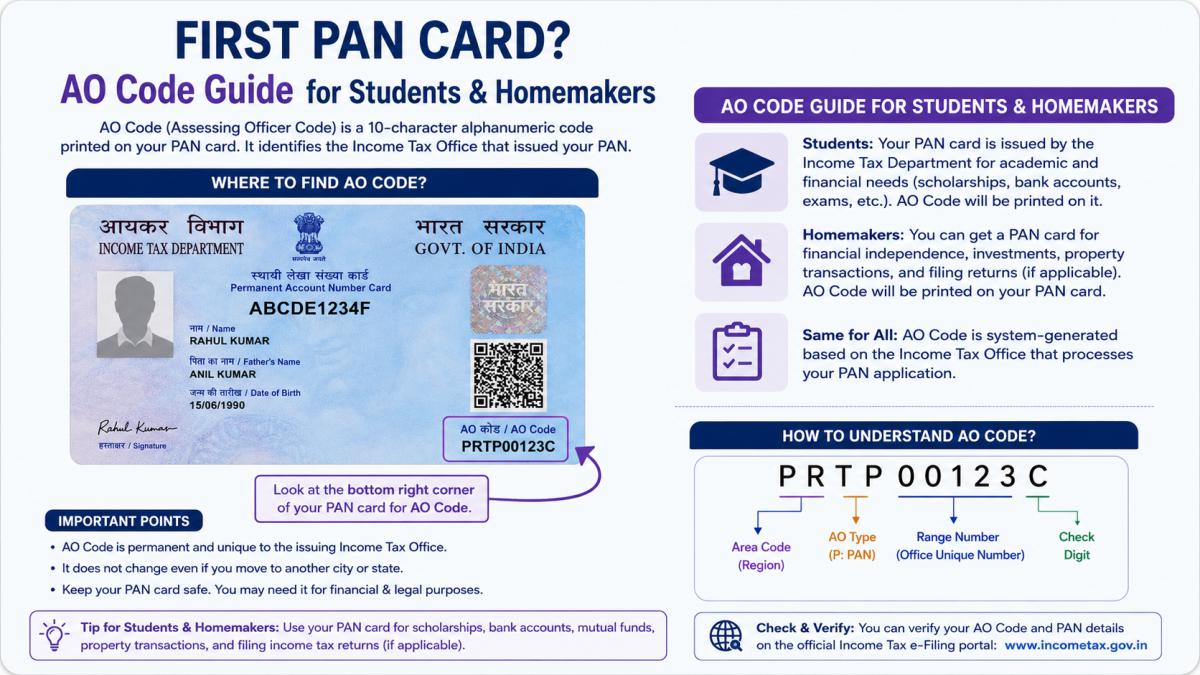
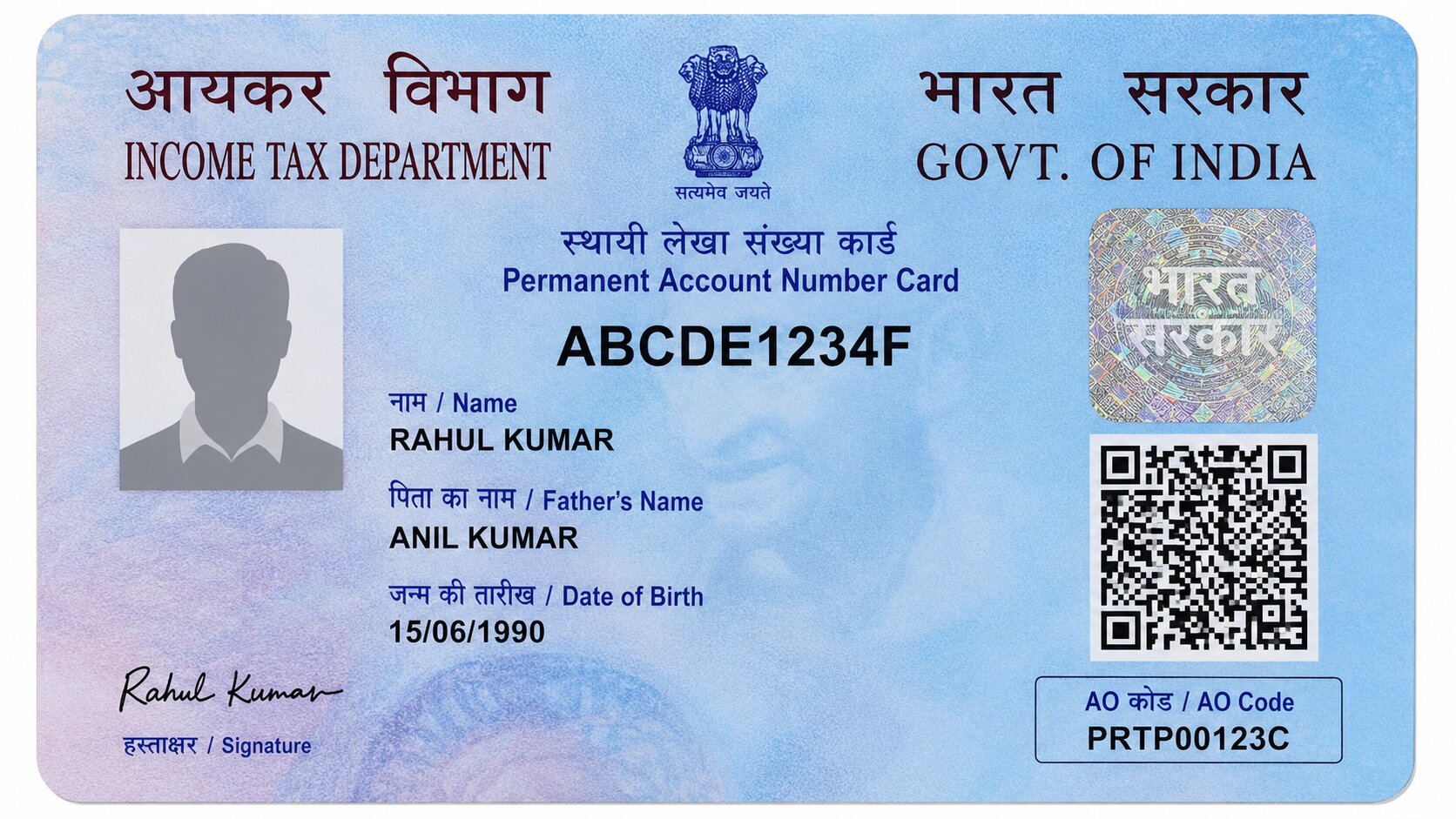
AO stands for Assessing Officer. The AO code is a short code that tells the Income Tax Department which officer's jurisdiction your PAN belongs to. That officer is the one who later assesses the income tax returns you file. So this one field on the form quietly decides which desk, in which office, handles your tax record for years to come.
It is mandatory. The PAN application does not go through without it, and choosing the correct one is the applicant's job, not the portal's. Pick the right code and your PAN lands with the correct officer from day one. Pick a wrong one and you create a small mess that needs a correction request to undo later.
The four parts of an AO code
An AO code looks cryptic until you break it into its four pieces. Once you see them, the string stops looking random.
| Part | What it means | Example idea |
|---|---|---|
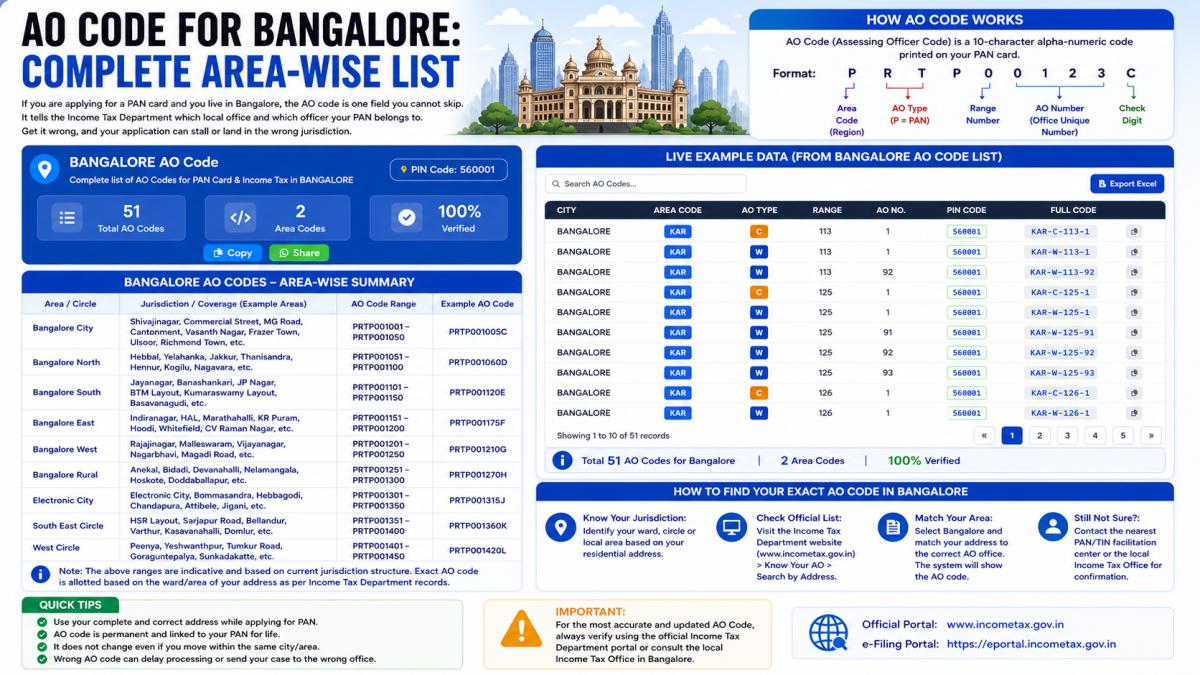
| Area Code | Three letters for your region of jurisdiction | MUM for Mumbai, DEL for Delhi |
| AO Type | The category of taxpayer, which decides Ward or Circle | W or C |
| Range Code | The range the officer sits under within that area | A number |
| AO Number | The specific officer's number inside that range | A number |
We cover each one in depth separately, because people search for them individually: the Area Code, the AO Type, the Range Code, and the AO Number. For a quick overview of how all four fit together, see the four parts of an AO code.
The four AO categories for PAN
Before the exact code, the form sorts you into one of four broad categories. Most people pick wrong here because the wording is confusing.
| Category | Who it is for |
|---|---|
| International Taxation | Foreign nationals, or companies not incorporated in India |
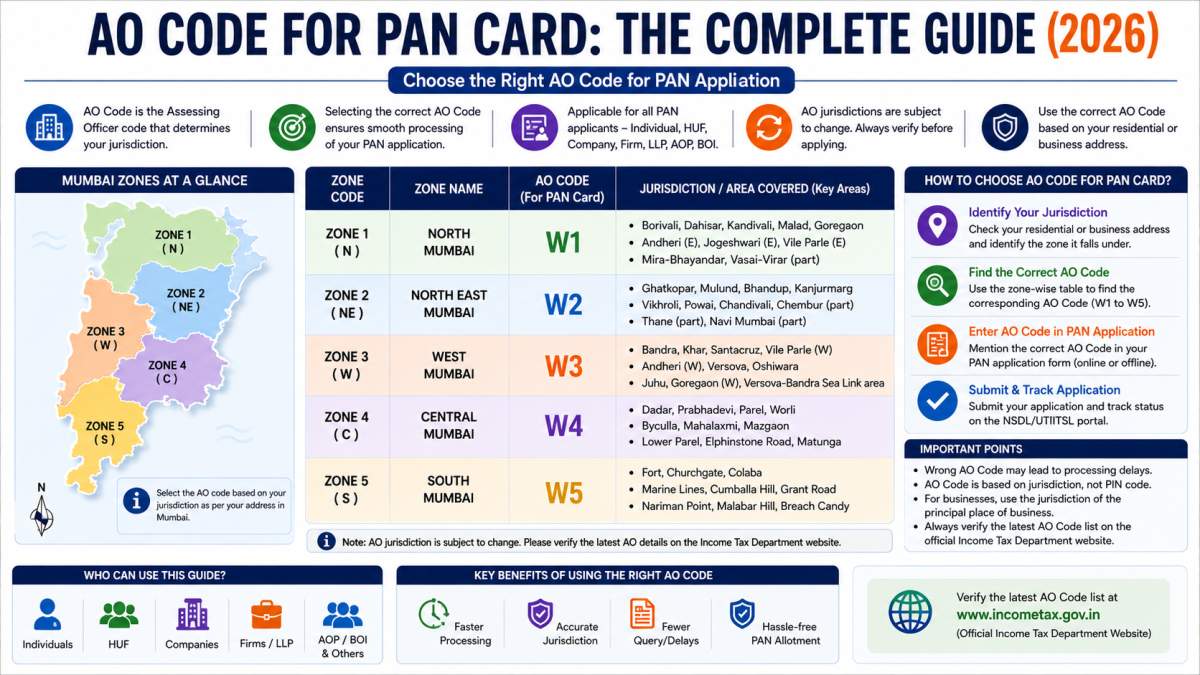
| Non-International Taxation (Mumbai Region) | People living in Mumbai and companies registered in Mumbai |
| Non-International Taxation (Outside Mumbai) | Everyone else in India who is not in Mumbai |
| Defence Personnel | Indian Army and Indian Air Force members, with separate codes for each |
Notice the odd one out. Every city in the country falls under "Outside Mumbai" except Mumbai, which has been given its own category. So if you live in Mumbai, you want the Mumbai Region option, not Outside Mumbai. This single confusion sends more applications to the wrong place than anything else.
Ward or Circle: the letter that matters
Inside your category, the AO Type letter decides what kind of officer handles your file. Two letters do most of the work.
- W (Ward) is generally for salaried individuals and lower income brackets. For most ordinary first-time applicants, this is the common one.
- C (Circle) is generally for companies, firms, HUFs, and higher-income individuals.
The deciding factor is your income and what kind of taxpayer you are, not where you live. A salaried person on a normal salary usually sits in a Ward. A company or a business with larger income usually sits in a Circle.
How to find your AO code
You do not guess this code. You look it up from a source that is current for your address. There are three reliable routes depending on your situation.
1. You are applying for a new PAN
Use the AO code search on the Protean (formerly NSDL) TIN portal. Open the search, pick your category, and match your locality or address to the right code. Copy all four parts into your form. You can also find it faster by pin code on this site.
2. You already have a PAN
Do not bother with the application search. Use the "Know Your AO" service on the Income Tax e-filing portal, enter your PAN, verify with OTP, and it shows your current officer. This matters because your AO can change over time even though your PAN stays the same. We explain this in the Know Your AO and PAN jurisdiction guide.
3. Step by step
If you want the full walkthrough with screenshots-style steps, follow the step by step guide to finding your AO code for PAN.
Salaried or self-employed: which address decides your code
This trips up more people than the category question. The address that fixes your jurisdiction depends on how you earn.
- If you are salaried, your jurisdiction usually follows your office or employer location.
- If your income is from business or you are self-employed, it usually follows your residential address.
If you recently changed jobs or moved house, this is exactly the kind of detail that lands an application in the wrong ward. Match the code to where you actually fall now.
Does the AO code affect my ITR?
Yes, and that is the whole reason to get it right early. The officer whose code you carry is the one who assesses your returns. If they find a discrepancy in your ITR, they are the authority who asks you to explain it. So a correct code at the PAN stage saves you friction at the filing stage.
Common mistakes to avoid
- Copying a random AO code from a friend or an old form. Their jurisdiction is not yours.
- Mumbai residents picking "Outside Mumbai" because the two options sit side by side.
- Salaried applicants using their home address when their jurisdiction should follow the office.
- Assuming the PAN AO code also works for TAN. It does not. TAN has its own separate code, explained in the TAN AO code guide.
A note for special cases
Students, homemakers, minors, and people with no taxable income often worry about which code to use. There is a simple answer for them in the AO code for students, housewives and minors guide. And if you are applying under the 2026 rules with the new forms, read AO code and the new PAN forms 93, 94, 95, 96.
Frequently asked questions
What is the AO code in a PAN card application?
It is a code identifying the Assessing Officer whose jurisdiction your PAN falls under. It is made of an Area Code, AO Type, Range Code, and AO Number.
Is the AO code mandatory?
Yes. The PAN application cannot be submitted without it, and you are responsible for choosing the correct one.
How do I find my AO code?
Search it on the Protean TIN portal when applying, or use "Know Your AO" on the Income Tax e-filing portal if you already hold a PAN. You can also look it up by pin code on this site.
I am salaried. Ward or Circle?
For a salaried individual on a normal salary, a Ward (W) code is the usual fit. Companies and higher-income or business cases go to Circle (C).
Can I use any Mumbai code just to get past the form?
You can enter one, but it is not advisable. The correct code routes your PAN to the right officer and saves you a correction later.
This data is verified from the official Protean (NSDL) TIN portal and the Income Tax Department's PAN and Know Your AO services. AO codes and jurisdictions are restructured periodically by the Income Tax Department, so always confirm your exact code on the official portal or this site's lookup before submitting. Last verified May 2026.