PAN Card New Rules 2026: New Forms 93, 94, 95, 96 and Everything That Changed from April 1
For years, getting a PAN was almost too easy. Punch in your Aadhaar, verify an OTP, done. I have watched people apply from their phone in a tea stall and have the e-PAN before the chai went cold. That era ended on April 1, 2026. The old Form 49A and 49AA are retired, four new forms have replaced them, and Aadhaar alone will no longer carry your application across the line.
If you only remember one thing, remember this: your existing PAN card is still valid and you do not need to reapply. Everything below is about new applications, corrections, and the people whose name on PAN does not match their Aadhaar. That last group is bigger than most people think, and it is the group that is going to feel this change the most.
Why the government broke a system that worked
The single-Aadhaar route made PAN accessible in minutes. The flip side was that the same convenience let duplicate and fraudulent PANs slip through, because one document was doing all the verification work. The Income-tax Rules, 2026, notified by the CBDT under the Income-tax Act, 2025, tighten that. More proof, stricter name matching, and category-specific forms so each applicant submits only what is relevant to them.
My honest read: it will frustrate first-time applicants who are used to the instant version, and it will genuinely cut down on the messy duplicate-PAN cases that clog up the system later. Whether that trade is worth the extra friction depends on which side of the counter you are sitting on.
The four new forms, and who actually uses which
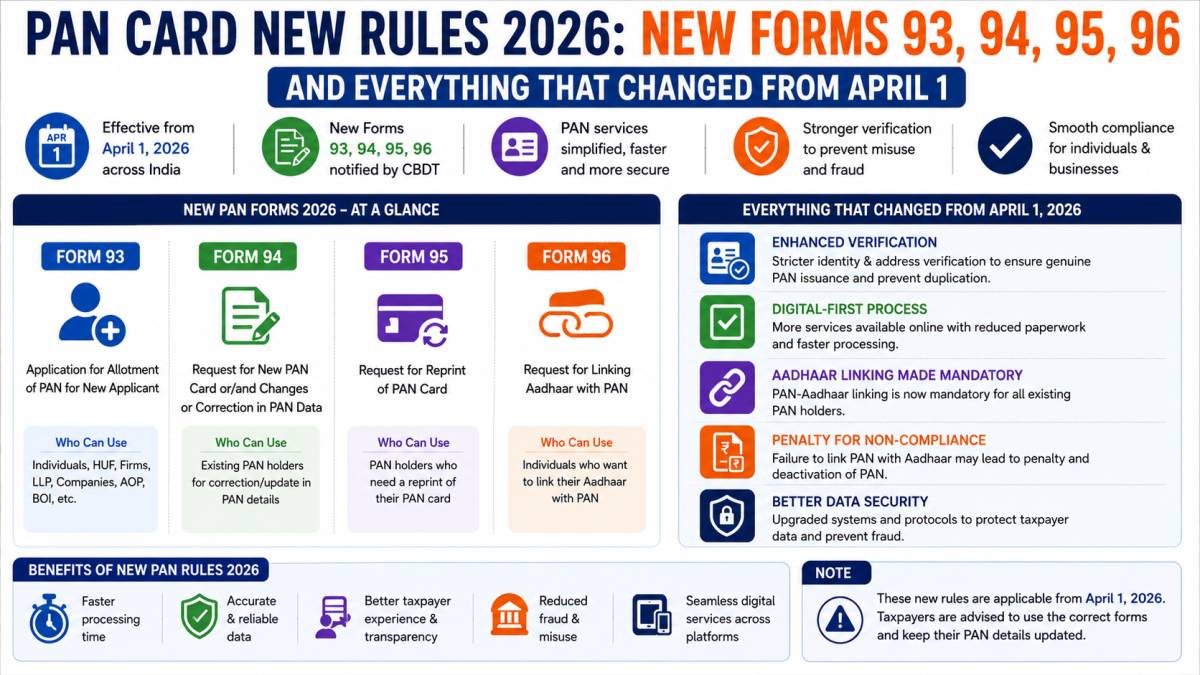
Two forms became four. The split is by applicant category, notified under Rule 158 read with Section 262.
| Form | Who it is for | Old form it replaces |
|---|---|---|
| Form 93 | Individuals who are citizens of India (including NRIs holding Indian citizenship) | Form 49A |
| Form 94 | Indian companies and entities incorporated or formed in India | Form 49A |
| Form 95 | Individuals who are not citizens of India | Form 49AA |
| Form 96 | Entities incorporated or formed outside India | Form 49AA |
For the overwhelming majority of readers, the answer is Form 93. If you are a salaried person, a student, a shopkeeper, a farmer, or a homemaker applying for the first time, and you hold Indian citizenship, Form 93 is your form. Form 94 is the company and entity version. Forms 95 and 96 are the foreign individual and foreign entity versions.
Filing the old Form 49A or 49AA on or after April 1 gets the application rejected outright. There is no grace period for the wrong form.
What Form 93 asks for now
The form itself is leaner in some places and stricter in others. A few things on it are new enough that people fill them wrong out of habit.
- Name exactly as per Aadhaar. The name is entered in full, first, middle, and last, in block letters, with no abbreviations. Whatever sits in your Aadhaar is what prints on the PAN.
- Mother's name is now mandatory. It used to be optional. The form also lets you choose whether the father's or mother's name is the one printed on the card.
- Mobile number and email are compulsory. No more leaving these blank. They are how you get the e-PAN and status updates.
- A larger, clearer photo. The form expects recent colour photographs on a white background, one pasted in the declaration block with your signature across it.
- Residency status. You declare whether you are Resident, NRI, or RNOR. NRI and RNOR applicants also give passport details and a TIN.
- A declaration that you do not already hold a PAN. Signing this falsely carries legal consequences under the Income-tax Act, 2025. Holding two PANs has always been a problem; the form now puts that liability in front of your face before you sign.
One more practical point that trips people up: once you submit, you cannot edit. There is no going back to fix a typo. Any change after that has to go through a separate correction request after the PAN is allotted. So slow down on the review screen.
The document trio, and the Aadhaar trap nobody warns you about
Under Rule 158, three kinds of documents now come with your application: Proof of Identity, Proof of Address, and Proof of Date of Birth. The first two existed before in spirit. The third, a separate date-of-birth proof, is the real new requirement and the one that will cause the most rejections.
Here is the trap. People assume Aadhaar settles the date of birth too. It often does not. If your Aadhaar shows only the year of birth rather than the full date, it will not be accepted as date-of-birth proof, and your application stalls. I have seen this exact thing send applications back. The fix is simple if you plan ahead: carry a passport, voter ID, driving licence, or Class 10 certificate for the date of birth instead of leaning on Aadhaar for it.
| Document type | Commonly accepted options |
|---|---|
| Proof of Identity | Aadhaar, Indian passport, voter ID, driving licence, ration card with photo, government photo ID, or an identity certificate signed by an MP, MLA, Municipal Councillor, or Gazetted Officer |
| Proof of Address | Aadhaar, passport, voter ID, driving licence, post office passbook, property documents, or recent utility bills (electricity, phone, water, gas, bank statement) within the allowed period |
| Proof of Date of Birth | Birth certificate, Class 10 / matriculation certificate, passport, voter ID, driving licence, or an affidavit before a magistrate. Aadhaar only if it carries the full date, not just the year. |
One specific rule worth flagging for young families: for individuals born on or after October 1, 2023, the birth certificate is mandatory as the date-of-birth proof. If you are applying for a child in that bracket, the birth certificate is not optional.
Your name will follow Aadhaar, like it or not
The old "Name on Card" customisation is gone. You can no longer print a tidied-up version of your name that differs from Aadhaar. The PAN takes the Aadhaar name as it is.
This is why I keep telling people to fix Aadhaar first and PAN second. If your Aadhaar has a spelling error, a maiden name you no longer use, or a missing surname, that flaw walks straight onto your new PAN. Correcting it afterwards means a separate correction request, more time, more documents.
On initials, the rule is precise. Initials are not allowed in the name by default. The exception: if your Aadhaar name itself contains initials, those are permitted, but you must provide the expanded full name with supporting documents. For exempt categories, initials in the first and last name are not allowed at all.
When Aadhaar is not mandatory
Aadhaar is mandatory for Indian citizens applying under Form 93, with one carve-out: exempt categories. The clearest example is NRIs who have been outside India beyond the threshold period in a financial year. They fall under the exempted category and can apply without Aadhaar.
For a non-citizen using Form 95, the Indian passport does double duty as proof of identity and proof of date of birth, while a bank statement or utility bill from the country of residence covers the address. A TIN from the country of residence comes into play for these applicants too.
Minors and the Representative Assessee
Minors can still get a PAN. For a minor, alongside the minor's Aadhaar and photograph, you also submit proof of identity and proof of address of the Representative Assessee, the adult filing on the child's behalf.
The form now takes the Representative Assessee more seriously. It asks for the RA's contact details and the RA's PAN or Aadhaar, so there is a real, traceable person standing behind a minor's or a dependent's application. The address for communication can be the residential address, the office address, or the Representative Assessee's address.
Corrections work differently now
Fresh applications and corrections are no longer the same paperwork. Corrections have their own forms.
- PAN CR-01 for individuals
- PAN CR-02 for non-individual entities
These can be filed online through Protean or UTIITSL, or physically at a PAN service centre. And to repeat the point that bites people: because you cannot edit a submitted application, a mistake on a fresh Form 93 does not get fixed on that form. It gets fixed later through a correction request, which is slower than getting it right the first time.
The high-value transaction angle
The 2026 rules did not stop at application forms. They also revised some thresholds for when quoting PAN becomes mandatory on large transactions. As reported, the trigger for cash deposits or withdrawals moved to an annual basis, with PAN required where the yearly total reaches around ten lakh rupees, rather than the older per-day figure. Thresholds differ by transaction type, so treat that number as a pointer and confirm the current limit for your specific situation on the official portal before you rely on it.
How to actually apply
The route has not changed even if the form has. You apply through Protean (formerly NSDL eGov), UTIITSL, or the Income Tax Department's e-filing portal, and you download Forms 93, 94, 95, or 96 from the authorised service providers.
- Check your Aadhaar first. Confirm the name and the full date of birth are correct, because your PAN will inherit them.
- Pick the right form. An individual Indian citizen uses Form 93.
- Gather the three proofs, paying special attention to a separate date-of-birth document if your Aadhaar shows only the year.
- Fill in full name in block letters, mother's name, mobile, email, and residency status. Attach the photo.
- Review carefully, because there are no edits after submission, then submit and save the acknowledgement number to track status.
On timing, an Aadhaar-based online e-PAN usually comes through in a few working days, while the physical card lands later, generally in the region of a couple of weeks. Fees vary by service provider and by whether you want a physical card or just the e-PAN, and they differ for foreign addresses, so check the live fee on the portal rather than trusting an old figure.
Do not get scammed in the confusion
Whenever rules change, fraud rises, because confused people click things they normally would not. The government has warned about fake "download your e-PAN" emails and messages doing the rounds. No genuine authority will ask you to share financial or sensitive details over an email link, an SMS, or a phone call. Apply only through the official portals, and treat anything else as bait.
What existing PAN holders should do
Mostly nothing. Your card stays valid, and there is no rule pushing you to reapply. Applications that were already pending on March 31, 2026 also remain valid under the old form.
The one thing worth doing voluntarily: if the name or date of birth on your PAN does not match your Aadhaar, sort it out. That mismatch is increasingly the thing that gets a bank transaction, an ITR, or a KYC stuck. Nobody is forcing you, but future-you will be glad you did it before it became urgent.
Frequently asked questions
Which form does an ordinary Indian citizen use?
Form 93. It is the PAN application for individuals who are citizens of India and replaces Form 49A for them.
Is my old PAN card invalid now?
No. Existing PAN cards remain fully valid and there is no need to reapply because of the rule change.
Can I still apply using only Aadhaar?
Only up to March 31, 2026. From April 1, 2026, you also need a separate proof of date of birth, and Aadhaar will not be accepted as that proof if it shows only the birth year.
What if my Aadhaar name has a mistake?
Fix the Aadhaar first. Your PAN name is taken from Aadhaar, so the error would otherwise print on your new PAN and need a separate correction.
Can a minor get a PAN under the new rules?
Yes. Along with the minor's Aadhaar and photograph, the Representative Assessee submits their own proof of identity and address and provides their PAN or Aadhaar and contact details.
What happens if I make a typo on the form?
You cannot edit a submitted application. The correction goes through PAN CR-01 for individuals or PAN CR-02 for entities after the PAN is allotted.
Will the old Form 49A still work?
No. Any application filed on or after April 1, 2026 using the old forms is rejected.
This data is verified from the official Income Tax Department PAN page and the Form 93/94/95/96 FAQs (incometaxindia.gov.in), the Form 93 notified PDF on the Protean TIN portal (tinpan.proteantech.in), and corroborated against Business Today, ClearTax, and TaxGuru for the document lists and the Aadhaar date-of-birth nuance. The high-value transaction threshold is reported by Upstox and should be reconfirmed on the official portal for your specific transaction type. Processing times and fees vary by service provider and should be checked live on the portal. Last verified May 2026.