AO Code for Salaried Employees: How to Pick the Right One
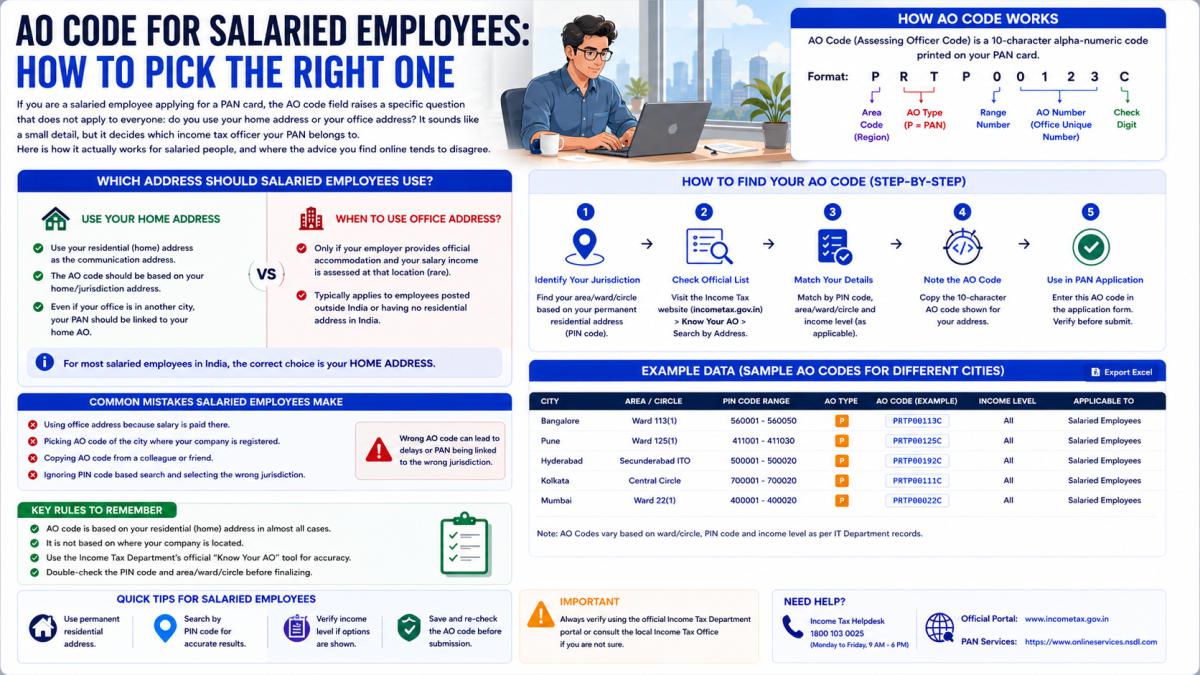
If you are a salaried employee applying for a PAN card, the AO code field raises a specific question that does not apply to everyone: do you use your home address or your office address? It sounds like a small detail, but it decides which income tax officer your PAN belongs to. Here is how it actually works for salaried people, and where the advice you find online tends to disagree.
What the AO Code Does
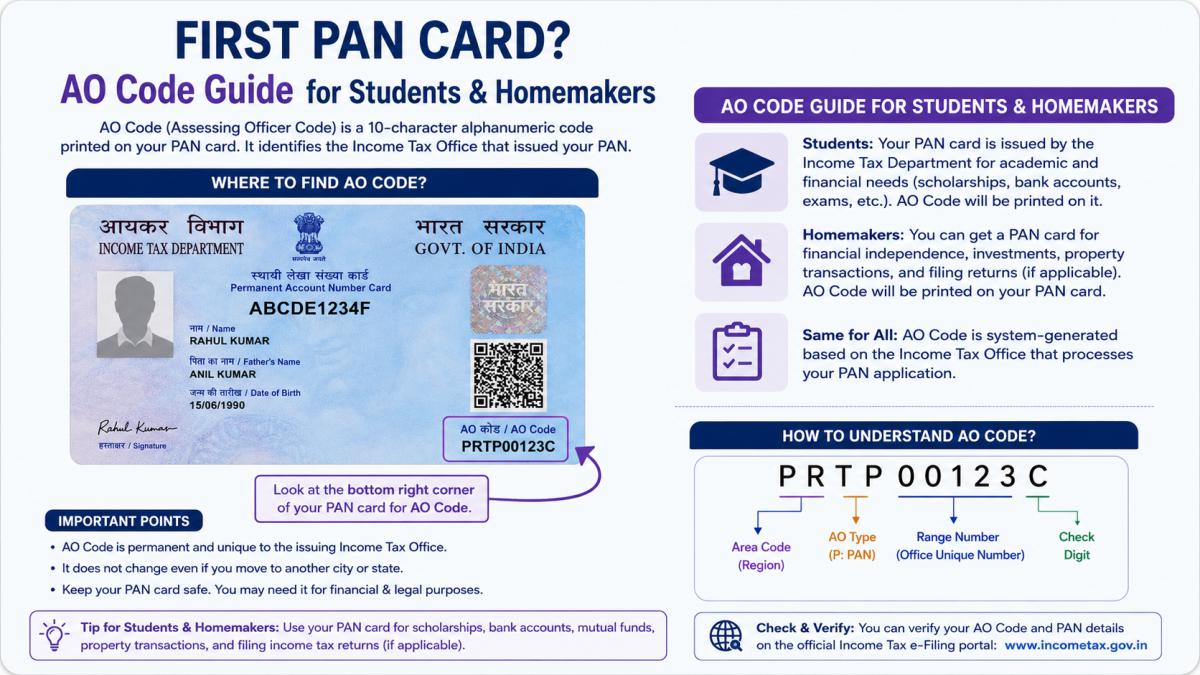
The AO code points your PAN to a specific Assessing Officer and tax jurisdiction. It is built from four parts: the area code (three letters for your region), the AO type (W for Ward, C for Circle), the range code, and the AO number. For most salaried individuals, the relevant type is a Ward, since wards generally handle individual taxpayers, while circles lean towards companies and higher-income cases.
The Core Rule for Salaried Employees
This is the part that matters most. The Income Tax Department determines an individual's AO code based on income type and address, and the standard logic is this:
- If your income is from salary, or a combination of salary and business, your AO code is generally based on your official or office address.
- If your income is from sources other than salary, your AO code is based on your residential address.
So as a purely salaried employee, the default position is to find the AO code that corresponds to your office address, because your employer's tax circle often determines your jurisdiction.
An Honest Caveat: The Advice Is Not Uniform
I want to be straight with you here, because this is the one area where guidance genuinely varies. While the standard determination logic ties salaried individuals to their office address, some advisories instead tell salaried people to use their residential address. Both views exist in circulation.
What this means in practice: do not treat either as gospel. The safest approach is to use the official search tool, look at the actual jurisdiction descriptions for your city, and pick the entry that genuinely matches your situation. If your office and home fall under different wards and you cannot tell which applies, that is the moment to confirm with the Income Tax Office rather than guess. Getting it slightly wrong is not catastrophic, since jurisdiction can be corrected later, but starting in the right place saves hassle.
How to Find Your AO Code as a Salaried Employee
Use one of the official, government-authorised tools. Do not copy a code off a random site.
Through the Protean (NSDL) PAN portal:
- Open the Protean PAN AO Search page.
- Select your city from the alphabetical list (use the city of your office address as a salaried employee).
- A table of AO codes appears with area code, AO type, range code, AO number, and descriptions.
- Read the descriptions and find the one covering your office locality and the salary income category.
Through the UTIITSL portal:
- Go to the UTIITSL PAN Card Services section and open "Search for AO Code Details".
- Choose the AO code type, then click View Details.
- Select your city using the matching alphabet.
- The codes display with all four parts and their descriptions.
If you already have a PAN and just want to check your current jurisdiction, the Income Tax e-filing portal has a "Know Your AO" option under Quick Links. Enter your PAN, verify with an OTP, and your assigned officer appears.
Reading the Descriptions
City lists for salaried employees often carry descriptions that mention salary explicitly, sometimes with income thresholds like "salaries up to 10 lakh" or specific PIN codes. To pick correctly:
- Confirm the area code matches your city.
- Look for entries in the individual category that mention salary income.
- Match the PIN code in the description to your office address PIN code.
- Check any income threshold against your own.
What Happens If Your Address Changes
If you switch jobs to a different city, or move house, your jurisdiction may change. You do not edit the AO code directly. You update your address through a PAN correction application, and the jurisdiction reassigns to match. So the AO code you pick now is not permanent; it follows your situation over time.
Quick Answers
Office address or home address for a salaried employee?
The standard rule ties salaried income to your office address. Some advisories say residential. When in doubt, use the official tool and match the description, or confirm with the Income Tax Office.
Ward or Circle?
Most salaried individuals fall under a Ward (W). Circles (C) lean towards companies and higher-income cases.
Can I leave it blank since I am just an employee?
No. The AO code is a mandatory field in the PAN application. A blank or wrong code can cause delays.
Bottom Line
As a salaried employee, the default is to base your AO code on your office address, find the individual-category entry that mentions salary income, and match the PIN code. The advice on home versus office is not perfectly uniform, so the reliable move is to read the official descriptions on the Protean or UTIITSL search and, if your office and home wards differ and you are unsure, confirm with the Income Tax Office before submitting.
Disclaimer: This is an informational guide, not a government website. AO codes are set and updated by the Income Tax Department of India. Always verify your code through the official Income Tax, Protean (NSDL), or UTIITSL portals before submitting your PAN application.