AO Code for Businesses and Partnership Firms: PAN Application Guide
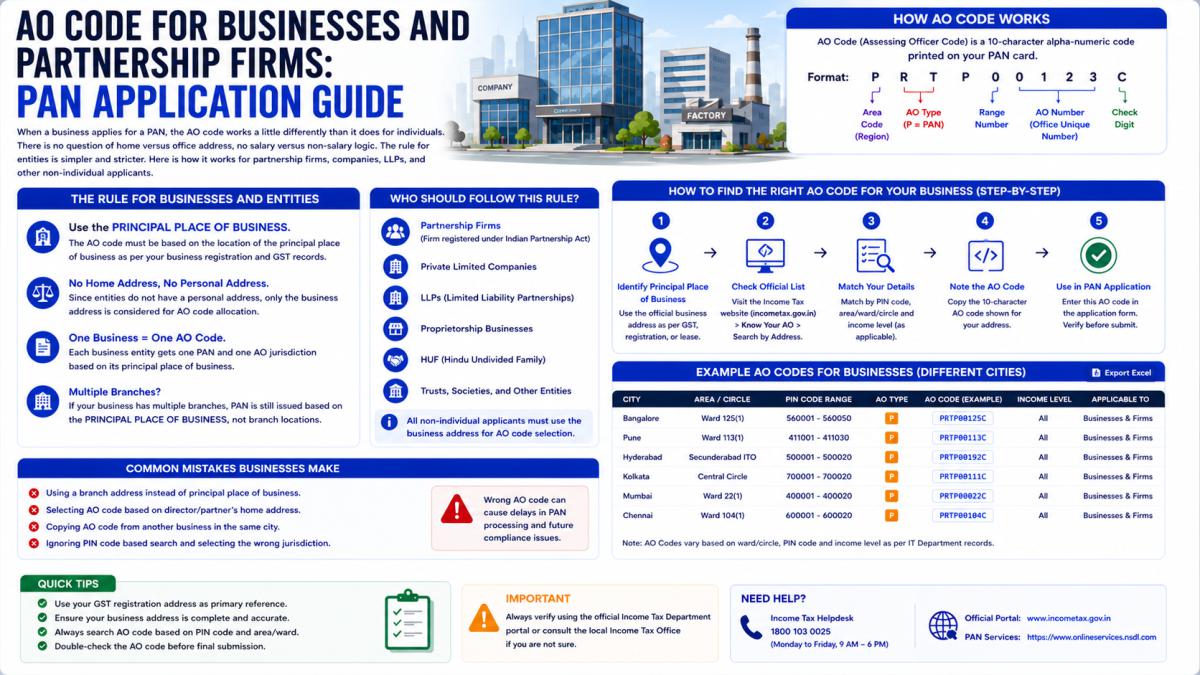
When a business applies for a PAN, the AO code works a little differently than it does for individuals. There is no question of home versus office address, no salary versus non-salary logic. The rule for entities is simpler and stricter. Here is how it works for partnership firms, companies, LLPs, and other non-individual applicants.
The Rule for Non-Individual Entities
This is the part to get right first, because it applies to almost every business structure. For a Partnership Firm, LLP, Company, HUF, Trust, Association of Persons, Body of Individuals, Local Authority, Government Body, or Artificial Juridical Person, the AO code is decided by the office or registered business address. Not the address of any partner or director. The entity's own registered office is what determines its jurisdiction.
This is also backed by the official PAN application rules. The instructions for the application form state that for a Firm, LLP, Company, Local Authority, or Trust, the name and complete address of the office is mandatory, and the address for communication must be the office address. So for a business, the office address is not optional, and it drives the AO code.
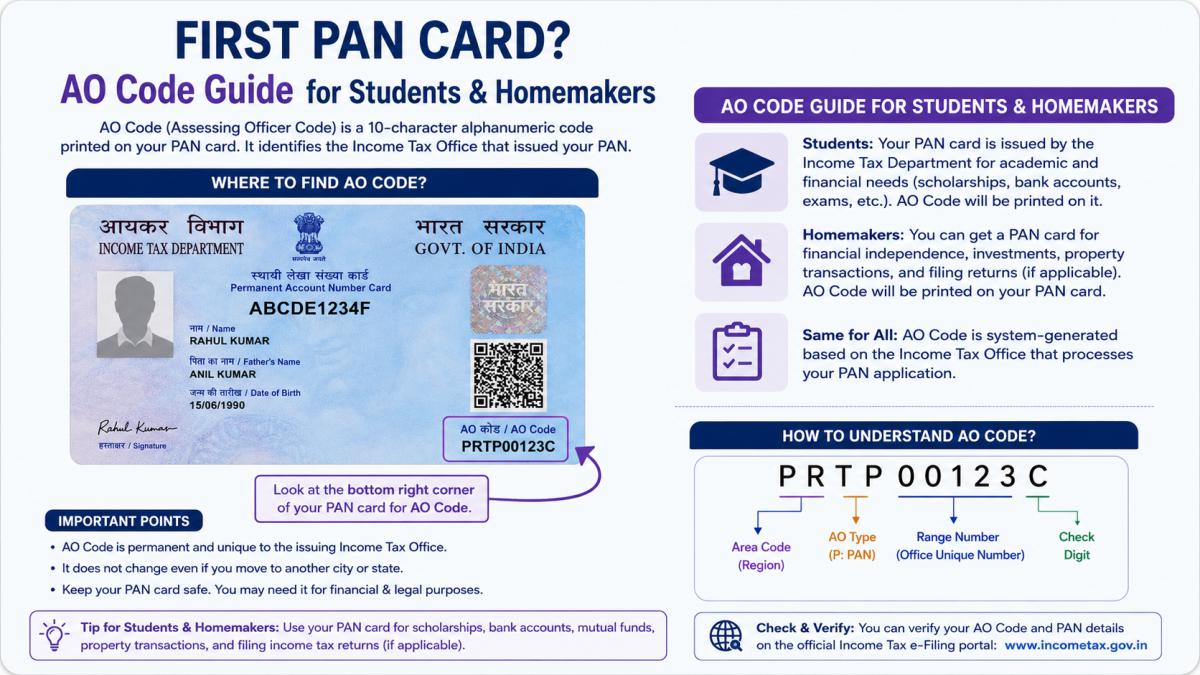
The Four Parts of the Code
Like any AO code, a business code has four components:
- Area Code: three letters for the region of the registered office.
- AO Type: W for Ward, C for Circle. Companies and higher-turnover entities often fall under Circles.
- Range Code: the number for the specific range covering the office address.
- AO Number: the individual Assessing Officer's number.
Why Businesses Often Fall Under a Circle
For individuals, wards are common. For businesses, you will more often see Circle (C) entries, since circles generally handle company cases and higher-income or higher-turnover assessees. That said, smaller firms can still fall under wards depending on the jurisdiction. The description in the official list will tell you which applies, often mentioning companies, registered offices, or turnover thresholds.
A Note on LLPs
One practical detail for Limited Liability Partnerships: under the PAN rules, an LLP's PAN is allotted in "Firm" status. So when you select your category and read the descriptions, an LLP is treated alongside firms rather than as a separate type. Keep that in mind so you do not go looking for an "LLP-only" entry that does not exist.
How to Find Your Business AO Code
Use an official, government-authorised tool. Search by the city of your registered office.
Through the Protean (NSDL) PAN portal:
- Open the Protean PAN AO Search page.
- Select the city of your registered office from the alphabetical list.
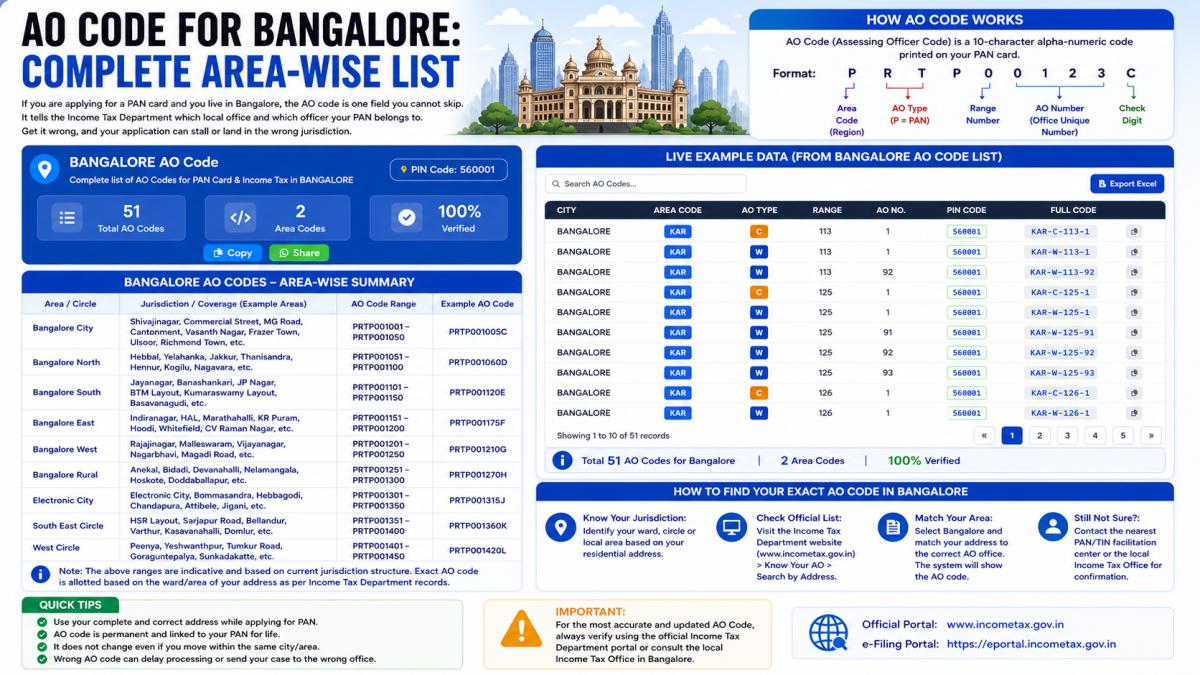
- A table of AO codes appears with area code, AO type, range code, AO number, and descriptions.
- Choose the non-individual category and read the descriptions for company or firm cases that cover your office locality.
Through the UTIITSL portal:
- Go to the UTIITSL PAN Card Services section and open "Search for AO Code Details".
- Choose the AO code type, then click View Details.
- Select your office city using the matching alphabet.
- The codes display with all four parts and their descriptions.
If the entity already has a PAN and you want to confirm its current jurisdiction, the Income Tax e-filing portal's "Know Your AO" option works with the entity's PAN.
Reading the Descriptions for Businesses
Business entries in the official lists are often split by:
- Entity type: separate descriptions for companies versus non-company assessees.
- Income or turnover thresholds: cases above a certain figure routed to circles.
- Name alphabet: in some cities, company or firm cases are split by the first letter of the registered name.
- PIN code or locality: tied to where the registered office sits.
Match all of these against your firm's actual details. Picking the wrong one can route your PAN to a jurisdiction that does not handle your type of entity.
If the Registered Office Changes
If your firm shifts its registered office to a new jurisdiction, the AO code needs to follow. You do not edit it directly. You update the office address through a PAN correction application, and the jurisdiction reassigns. For a company, registered office changes also involve Registrar of Companies filings separately, but for PAN purposes it is the address update that moves your AO.
Bottom Line
For any business entity, the AO code is decided by the registered office address, full stop. Select your city, choose the non-individual category, and read the descriptions to find the entry matching your entity type and any turnover or name split. LLPs are handled in Firm status. Use the official Protean or UTIITSL search, and if the descriptions are unclear for your office location, confirm with the local Income Tax Office before submitting.
Disclaimer: This is an informational guide, not a government website. AO codes are set and updated by the Income Tax Department of India. Always verify your code through the official Income Tax, Protean (NSDL), or UTIITSL portals before submitting your PAN application.